“Love me some shrimp and crabs for dinner, with a side of fish”
Picture: Luthfianto Hadi Nugroho | EPI
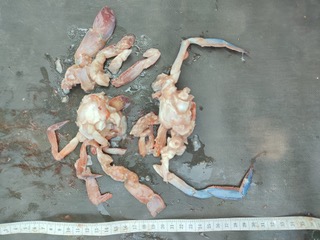
Rhinorays inhabiting the waters of Karimunjawa National Park (KJNP), particularly giant guitarfish and wedgefish, seem to enjoy the luxury of preying on shrimp and crabs, as discovered elsewhere.
To understand what rhinorays eat and which prey they prefer, the Elasmobranch Project Indonesia (EPI) team examined the stomachs of the rhinorays daily as part of the diet study. This study is essential for understanding their ecology and has revealed several unique findings.
It was found that one of the most abundant prey species in the stomachs of these species was an unidentified species of tiny shrimp. It is fascinating to learn that big fish like rhinorays, which can grow up to three metres long, appear to favour small crustaceans more than other food available on the seafloor.
Aside from the types of prey, the team also found a greyish gravy sauce, which was a mix of sand and mud, inside their stomachs. This finding reflects the habitat where rhinorays feed. As a bottom-dwelling fish, rhinorays love sandy and muddy surfaces. Here, the sand and mud would have been inevitable when they suck their food with their big mouths. Naturally, this finding raises another interesting question: is their stomach strong enough to pump out the sand and mud swallowed as they enjoy their dishes?
Read more about the details of the prey in the full article, published in Save Our Seas Blog, December 2024. The original version was written by Nyimas Alvynna Keneisha Zahra.